




Emergency 0484 7185000

 Second Opinion
  Book
an Appointment
Book
an Appointment
 Our Doctors
Offcanvas
Emergency
0484 7185000
Call Us
8593882299
Centres of Excellence




0484 7185000
8593882299
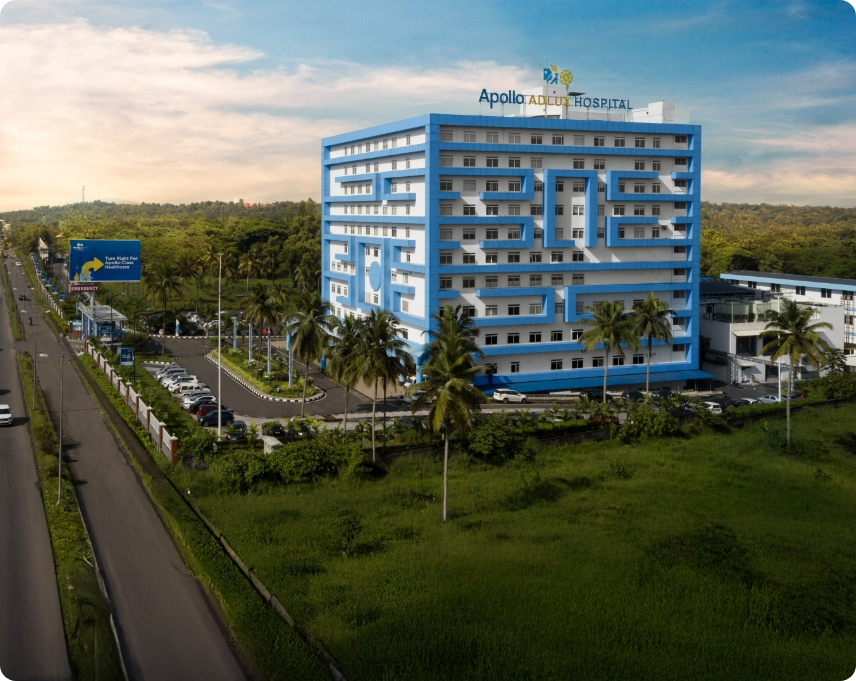
Traditional neurosurgery may require a relatively large opening to reach a condition located deep within the brain or skull base. Advances in neuroendoscopy now allow surgeons to perform selected procedures through smaller surgical corridors using specialised cameras and instruments. Apollo Adlux Hospital, Kochi, is equipped with Karl Storz Endoscopic Systems for minimally invasive brain, ventricular and skull-base procedures. Karl Storz provides neuroendoscopic solutions for intraventricular, cranial and skull-base conditions, combining specialised imaging systems and surgical instruments.
Neuroendoscopy is a surgical technique in which a thin instrument known as an endoscope is used to view and access structures within the brain, ventricles, skull base or spine. An endoscope typically includes:
The camera transmits enlarged images to a monitor, enabling the neurosurgeon to operate through a small opening or a natural anatomical passage.
Neuroendoscopy may be performed using several approaches.
This technique accesses the fluid-filled spaces within the brain known as ventricles. It may be used to treat selected forms of hydrocephalus, cysts or intraventricular tumours.
The surgeon reaches the skull base through the nose and nasal passages, avoiding an external facial incision. It may be considered for selected:
An endoscope may be used together with a surgical microscope to view areas that are difficult to see directly.
Selected spinal disorders may be treated through small incisions using an endoscopic camera and specialised instruments.
Hydrocephalus occurs when cerebrospinal fluid accumulates within the brain’s ventricles, potentially increasing pressure. In selected patients, a procedure called endoscopic third ventriculostomy may be performed. The surgeon creates a small opening to allow cerebrospinal fluid to flow through an alternative pathway. The suitability of this procedure depends on:
Some patients may still require a cerebrospinal fluid shunt.
The skull base contains several important nerves, arteries and glands. Certain lesions in this region can be approached through the nose using an endoscopic endonasal technique. This may provide a direct pathway to selected midline skull-base conditions. Potential benefits in suitable cases may include:
The approach is not suitable for every skull-base tumour. The location, size and relationship to surrounding structures must be carefully assessed.
Karl Storz Endoscopic Systems may support selected procedures involving:
Treatment decisions are based on MRI or CT findings and a detailed neurological assessment.
Depending on the procedure, possible benefits include:
These benefits cannot be guaranteed and vary according to the disease and procedure.
Although neuroendoscopy is minimally invasive, it remains a major surgical procedure. Potential risks may include:
The neurosurgeon will explain risks specific to the planned procedure.
Advanced endoscopic visualisation may be combined with neuronavigation, surgical microscopy and neurocritical care to support complex procedures.
Apollo Adlux Hospital provides multidisciplinary care involving neurosurgeons, ENT skull-base surgeons, neuro-anaesthesiologists, radiologists, endocrinologists and neurointensive care specialists. Patients seeking neuroendoscopy, endoscopic pituitary tumour surgery or minimally invasive skull-base surgery in Kochi can consult the experienced Neurosciences team at Apollo Adlux Hospital.