




Emergency 0484 7185000

 Second Opinion
  Book
an Appointment
Book
an Appointment
 Our Doctors
Offcanvas
Emergency
0484 7185000
Call Us
8593882299
Centres of Excellence




0484 7185000
8593882299
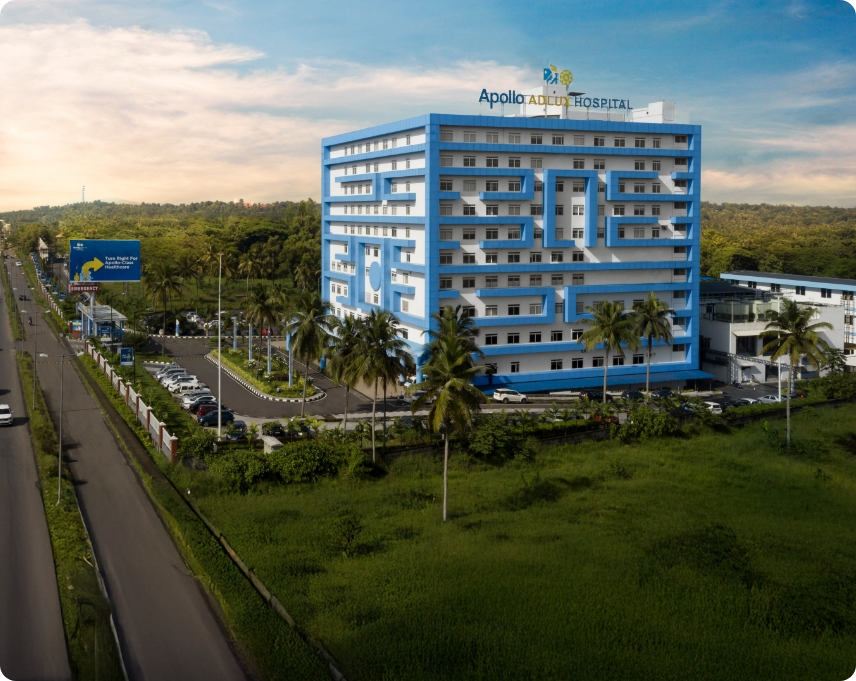
The brain, spinal cord and surrounding nerves contain several closely positioned structures that control movement, speech, vision, sensation and other essential functions. Neurosurgical procedures therefore require careful planning, precise visualisation and accurate localisation of the area being treated. Apollo Adlux Hospital, Kochi, is equipped with the Medtronic StealthStation S8 Neuronavigation System, which supports image-guided brain and spine procedures. Neuronavigation can be compared to a GPS system used during surgery. It helps the neurosurgeon understand the position of surgical instruments in relation to the patient’s anatomy using previously acquired imaging data.
A neuronavigation system combines imaging, computer software and instrument-tracking technology to help surgeons locate anatomical structures during surgery.
The Medtronic StealthStation S8 is designed to precisely locate anatomical structures during open or percutaneous neurosurgical and spinal procedures. It can integrate imaging datasets and track surgical instruments to assist the surgeon during an operation.
Before surgery, CT or MRI images may be uploaded to the system. These images can be used to:
Neuronavigation supports the surgeon’s clinical judgement rather than replacing surgical skill or decision-making.
The process generally involves the following stages:
The patient undergoes an MRI or CT scan. The images provide detailed information about the brain, spine, tumour, blood vessels or other anatomical structures.
The neurosurgeon studies and processes the images using navigation software. The safest route towards the surgical target can then be planned.
At the beginning of surgery, the patient’s actual anatomy is matched with the digital images displayed on the navigation system.
Specially recognised surgical instruments are tracked by the system. Their location is displayed in relation to the patient’s imaging data, helping the surgeon maintain orientation throughout the procedure.
Neuronavigation may support selected procedures involving:
The suitability of navigation depends on the diagnosis, location of the condition and the surgical approach selected.
Brain tumours may develop close to areas responsible for speech, movement, vision or memory. Neuronavigation helps the surgical team correlate the operative field with MRI or CT images.
This may help the neurosurgeon:
In some cases, neuronavigation may be combined with an advanced surgical microscope, fluorescence imaging, neurophysiological monitoring or endoscopic techniques.
In complex spine procedures, neuronavigation can help surgeons understand the three-dimensional anatomy of the vertebrae and surrounding structures.
It may support:
The technology is particularly useful where anatomical landmarks are difficult to visualise directly.
Depending on the procedure and patient’s condition, neuronavigation may support:
These potential advantages vary according to the diagnosis, complexity of the procedure and surgeon’s assessment.
Neuronavigation itself is a guidance technology. The risks associated with treatment are mainly related to the underlying disease and the surgical procedure being performed.
The accuracy of navigation depends on several factors, including:
The surgical team continuously correlates navigation information with actual anatomical findings.
Advanced Neuronavigation at Apollo Adlux Hospital, Kochi. The availability of the Medtronic StealthStation S8 Neuronavigation System at Apollo Adlux Hospital strengthens the hospital’s capability to perform complex brain and spine procedures using advanced image-guided techniques. The system works alongside experienced neurosurgeons, neuro-anaesthesiologists, radiologists, neurointensivists and specialised nursing teams. Patients searching for an advanced neurosurgery hospital, neuronavigation-assisted brain surgery or image-guided spine surgery in Kochi can access comprehensive evaluation and treatment at Apollo Adlux Hospital.